
Vegetables
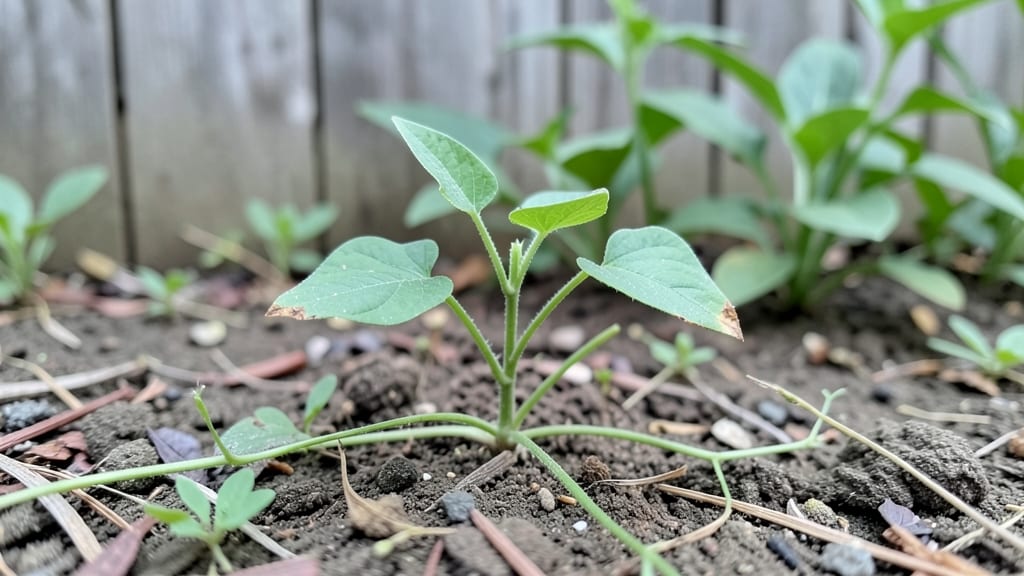
Identifying black bindweed seedlings starts with spotting their triangular clusters of glossy, arrowhead-shaped leaves that fan outward, typically emerging in late spring from tiny dark seeds buried just beneath the soil surface.
These young plants are often mistaken for harmless vines, but their distinctive leaf arrangement and rapid growth make them easy to spot if you know what to look for. 🌱 The key is catching them early—seedlings this size are far simpler to remove than fully established bindweed, which can smother gardens and lawns.
I've found that checking garden beds in early spring, before leaves fully unfurl, gives me the best chance to pull them before they take root.
Black bindweed thrives in disturbed soil and partial shade, which is why it often appears in garden beds or along fences where sunlight filters through. The shallow seed depth means even light rain can trigger germination, so consistent monitoring pays off.
Once you spot these seedlings, act fast—their roots develop quickly, making them harder to eradicate as they mature.
💡 In This Article
- Distinguishing Black Bindweed Seedlings from Similar Weeds
- Optimal Conditions for Black Bindweed Seedling Growth
Distinguishing black bindweed seedlings from similar weeds
Black bindweed seedlings have a distinctive triangular growth habit that sets them apart from look-alikes like morning glory or wild cucumber. Their leaves emerge in a perfect three-pointed fan, with each leaflet shaped like an arrowhead and pointing outward at roughly 120-degree angles.
This creates a symmetrical, almost geometric pattern when viewed from above. Morning glory seedlings, by contrast, produce heart-shaped leaves that grow in a more staggered, less uniform arrangement along the stem.
The stem texture is another key identifier: black bindweed seedlings develop a slightly hairy, waxy coating that gives them a slightly sticky feel when touched. Wild cucumber seedlings, meanwhile, have deeply lobed leaves with serrated edges and a more rugged, almost jagged appearance.
The bindweed's glossy leaves also reflect light differently—holding a seedling up to sunlight reveals a semi-transparent quality along the leaf veins, while other weeds appear more uniformly opaque. 🔍
What most gardeners overlook is how the growth pattern evolves as seedlings mature. Black bindweed's characteristic twining habit begins almost immediately—you'll notice the stem starts curling clockwise as soon as it reaches 2-3 inches tall. This early twining distinguishes it from vines like wild cucumber, which grow more upright initially.
The seedling stage is also when the root system develops its signature deep, fibrous structure, making early removal critical before these roots establish.
Here's a quick visual comparison to commit to memory:
- Leaf Shape: Black bindweed = arrowhead (3-pointed); Morning glory = heart-shaped
- Growth Pattern: Bindweed = triangular clusters; Wild cucumber = lobed, serrated
- Stem Texture: Bindweed = waxy, slightly hairy; Others = smooth or fuzzy
- Early Behavior: Bindweed twines immediately; Others grow upright first
The challenge comes when seedlings are less than 1 inch tall—this is when they most closely resemble harmless ground covers.
At this stage, look for the subtle color variation: black bindweed's true leaves emerge with a darker green center that fades to lighter edges, while many imposters have uniformly colored leaves. The seedling's cotyledons (first leaves) are also slightly curved, another telltale sign when viewed under magnification. 💫
Remember this rule: if you see three identical arrowhead leaves growing in a perfect triangle, you're likely dealing with black bindweed. This pattern becomes less obvious as plants mature, so early identification gives you the upper hand in garden management.