
Trees
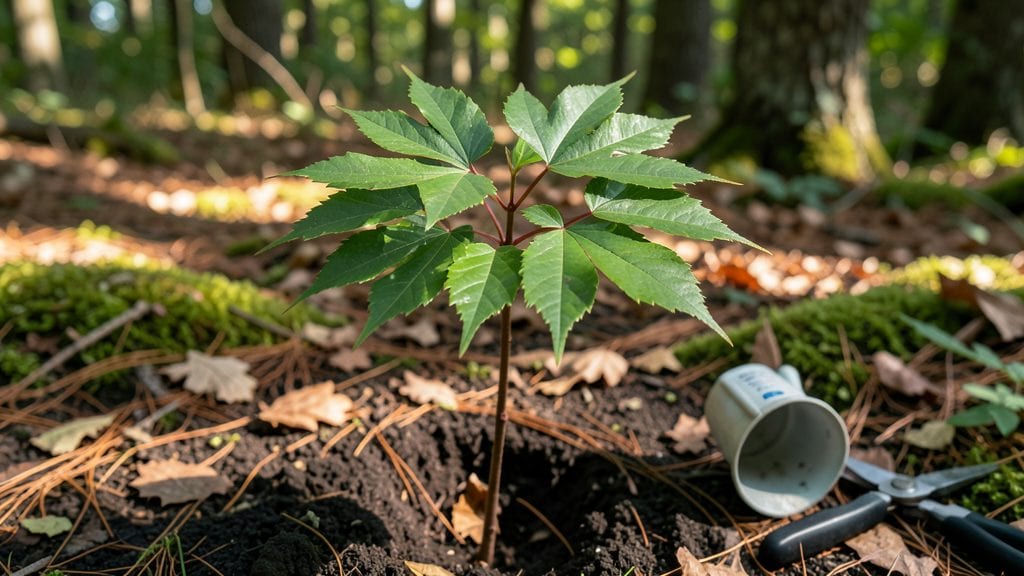
The identification of a maple tree seedling begins with its leaves—those distinct lobes and sharp points are your first clue. 🌿 I’ve spent years watching seedlings pop up in my yard, and the moment I spot those classic five-lobed leaves, I know I’m onto something special.
Sugar maples have serrated edges and a deep V between lobes, while red maples often show a more rounded shape with fewer teeth.
The real game-changer? Bud patterns. Maple buds grow opposite each other on the stem, unlike many other trees that have alternating buds. Silver maples, for example, have silvery undersides on their leaves and buds that stick out like tiny silver bullets.
These details matter because treating a sugar maple like a fast-growing silver maple could mean years of frustration—one needs patience, the other thrives in wet soil.
Once you’ve nailed the leaf shape and bud placement, check the bark. Young maples often have smooth, grayish bark with subtle ridges, while older trees develop deeper furrows.
This isn’t just trivia—knowing your maple type tells you how fast it’ll grow, how much sunlight it needs, and whether it’s worth saving if it’s in the wrong spot. A misidentified seedling could end up stunted or diseased if cared for incorrectly.
Why does this matter? Because maples are long-term investments. A sugar maple seedling you transplant now could be shading your porch in 20 years. Start with the leaves, then the buds, and finally the bark—this three-step method works every time. Now grab a magnifying glass and let’s get identifying!
Behind Seedling Confusion
Identifying maple tree seedlings can feel like solving a botanical puzzle—especially when similar species blur the lines. But why does this happen? The answer lies in a mix of genetic traits, environmental factors, and even human misconceptions.
Here’s a breakdown of the key reasons seedlings throw us for a loop.
Maple trees belong to the Acer genus, which includes over 125 species. Many of these species share striking similarities in early growth stages, making identification tricky. For example:
- Leaf shape: Sugar maples (Acer saccharum) and silver maples (Acer saccharinum) both produce palmately lobed leaves, but their lobing patterns and serration depths differ subtly. Young seedlings may not yet show these distinctions.
- Bud structures: Terminal buds (the main bud at the tip of a branch) can look nearly identical across species until the tree matures. Side buds, however, may reveal clues—like the opposite arrangement in sugar maples versus the alternate pattern in box elders (Acer negundo).
- Hybridization: Some maples, like the Freeman maple (a hybrid of red and silver maples), inherit a mix of traits, creating seedlings that defy easy classification.
Pro Tip: 🔍 Use a magnifying glass to inspect bud scars and leaf venation patterns—these often hold the key to distinguishing species before the tree fully develops.
Seedlings don’t grow in a vacuum—their environment shapes their appearance in ways that can mimic or mask species-specific traits. Here’s how:
- Light exposure: Seedlings grown in shade may develop smaller, less lobed leaves compared to those basking in sunlight. This can make a sugar maple seedling look suspiciously like a box elder.
- Soil nutrients: Nitrogen-rich soils can promote rapid, lush growth, while poor soil may stunt development. A malnourished seedling might lack the robust lobing of a healthy one, making identification harder.
- Water stress: Drought conditions can cause leaves to curl or shrink, altering their shape. Conversely, excessive moisture might lead to larger, thinner leaves that don’t match typical species profiles.
Actionable Tip: 🌡️ Compare seedlings from the same area—environmental factors will affect them uniformly, helping you spot anomalies that hint at a different species.
Even experienced gardeners can misidentify seedlings due to common pitfalls:
- Focusing on wrong traits: Many rely solely on leaf shape, ignoring critical details like bud arrangement or stem texture. For instance, box elder seedlings have compound leaves (multiple leaflets), while true maples have simple, lobed leaves.
- Seasonal timing: Buds and leaves emerge at different times for each species. A seedling with tight buds in early spring might be a red maple (Acer rubrum), while one with loose, hairy buds could be a silver maple.
- Overgeneralizing: Assuming all maple seedlings look alike leads to errors. For example, the Japanese maple (Acer palmatum) has finely divided lobes, while a swamp maple (Acer rubrum) has broader, more rounded ones.
Pro Tip: ✨ Take photos of seedlings from multiple angles—capturing buds, stems, and undersides of leaves will give you a fuller picture than a quick glance.
Seedlings undergo dramatic changes as they age. What looks like a sugar maple at 6 inches might transform into a silver maple by year three. Key transitions to watch:
| Age | Sugar Maple | Silver Maple |
|---|---|---|
| Year 1 | Simple, slightly lobed leaves; opposite buds | Broad, less defined lobes; buds may appear similar |
| Year 2+ | Distinct 5-lobed leaves with serrated edges | Deeply lobed, almost palmate leaves; serrations less pronounced |
Key Takeaway: Patience is critical. If a seedling’s traits are ambiguous, wait a season—maturity often reveals its true identity.
Fixing Common Maple Seedling Confusions
Identifying maple tree seedlings can feel like solving a botanical puzzle—especially when similar-looking species throw you off. But with the right approach, you can turn uncertainty into confidence. Below are practical, step-by-step solutions to the most common challenges, paired with prevention tips to keep your identification skills sharp.
Problem: Your seedling’s leaves resemble those of a silver maple, sugar maple, and boxelder—how do you tell them apart?
Solution:
- 🍁 Examine Leaf Lobes:
- Silver Maple: 5–7 lobes with deep, jagged notches (like a jagged heart).
- Sugar Maple: 5 lobes with sharper, more uniform serrations (think "fingers" with pointed tips).
- Boxelder: 3–5 lobes with uneven, almost wavy edges (often looks "messier").
Pro Tip: 💡 Hold the leaf up to light—sugar maples often have a translucent, veiny pattern that’s harder to see in others.
- 🌱 Check the Buds:
- Silver Maple: Buds are oval and sticky, with a single terminal bud.
- Sugar Maple: Buds are smaller, pointed, and clustered (like tiny brown cones).
- Boxelder: Buds are rounded and overlapping, often with a reddish tint.
- 🌿 Compare Seedling Growth:
- Silver maples grow fast and tall (up to 2 ft/year).
- Sugar maples are slower but sturdy, with a straighter trunk.
- Boxelders are weedy-looking, with thinner branches.
Prevention: 🌡️ Grow a reference chart with photos of mature leaves/buds from each species. Compare seedlings side by side under natural light.
Problem: Your seedling’s leaves are turning yellow or brown—is it a nutrient issue, pest damage, or something worse?
Solution:
- 🌧️ Rule Out Over/Underwatering:
- Yellowing edges? Likely underwatered (soil should stay moist but not soggy).
- Wilting + yellow stems? Overwatering (roots need air—check drainage!).
- 🐛 Pest Patrol:
- Aphids or mites? Look for sticky residue (honeydew) or tiny webs.
- Fix: Spray with neem oil or rinse leaves with soapy water.
- Borers? Check for sawdust-like frass near the trunk.
- Fix: Prune infested branches and treat with beneficial nematodes.
- Aphids or mites? Look for sticky residue (honeydew) or tiny webs.
- 🌱 Nutrient Deficiency:
- Pale green leaves? Lack of nitrogen (use a balanced fertilizer like 10-10-10).
- Purple stems? Phosphorus deficiency (add bone meal to the soil).
Prevention: ✨ Mulch properly (2–3 inches of wood chips) to retain moisture and deter pests. Inspect seedlings weekly for early signs of stress.
Problem: Your seedling is barely growing—is it the wrong soil, competition, or poor planting?
Solution:
- 🏡 Soil Check:
- Maple seedlings thrive in well-draining, slightly acidic soil (pH 6.0–7.0).
- Fix: Amend heavy clay with compost or sand. For sandy soil, add peat moss.
- 🌿 Light & Space:
- Too shady? Maples need at least 6 hours of sunlight.
- Too crowded? Remove nearby weeds or competing plants within a 2-foot radius.
- 🌱 Root Bound?
- If roots are circling the pot, transplant carefully—loosen roots before replanting.
Prevention: 🎯 Plant in early spring (avoid late summer heat stress). Water deeply 2–3 times a week (not daily shallow watering).
| Feature | Silver Maple | Sugar Maple | Boxelder |
|---|---|---|---|
| Leaf Lobes | 5–7, jagged | 5, sharp serrations | 3–5, uneven/wavy |
| Bud Shape | Oval, sticky | Pointed, clustered | Round, reddish |
| Growth Rate | Fast (2 ft/year) | Moderate (1 ft/year) | Weedy, aggressive |
| Bark | Gray, ridged | Smooth, greenish | Thin, brittle |
Final Tip: 🌟 Take photos of your seedling from multiple angles and compare them to online databases (like the USDA Plants Database). When in doubt, consult a local arborist or nursery expert—they’ve seen it all!
By tackling these issues head-on, you’ll master maple seedling ID in no time. Happy growing! 🌳🔍
Frequently asked questions
How can I tell if a maple seedling is a sugar maple or red maple?
Look at the leaf lobes and serration depth. Sugar maples have 5 sharp lobes with pronounced serrations, while red maples typically show 3-5 lobes with less defined edges. Also check the undersides—red maple leaves often have a slightly fuzzy texture, whereas sugar maples are smoother.
Why do some maple seedlings have compound leaves instead of simple lobed leaves?
Those are likely boxelder maples, not true maples. Boxelders have 3-5 leaflets (compound leaves) while genuine maples produce single, palmately lobed leaves. This key difference helps distinguish them from sugar, red, or silver maples.
At what age can I reliably identify a maple seedling?
For most species, you can make a confident ID at 1-2 years old when leaves develop full lobing patterns. However, some traits like bud arrangement are visible even in 6-month-old seedlings. Patience helps—waiting until spring bud break often reveals critical clues.
Can I use a smartphone app to identify my maple seedling?
Yes! Apps like LeafSnap or PictureThis use AI to analyze leaf shapes and compare them to databases. Just ensure good lighting and capture both the leaf and bud structure for accurate results. For best accuracy, combine app results with manual inspection of key traits.
What's the best time of year to identify maple seedlings?
Late spring (when leaves fully emerge) or early fall (before leaf drop) are ideal. During these times, leaf shapes are most distinct, and bud patterns are clearly visible before winter dormancy sets in.